Introduction
Most modern processors today are based on architectures controlled by companies like Intel and ARM. These architectures are powerful, but they are also proprietary and require licensing.
RISC-V is different.
RISC-V is an open-standard instruction set architecture (ISA) that allows anyone to design, build, and customize their own processors — completely free of licensing restrictions.
In this guide, you’ll learn what RISC-V is, how it works, and why it’s becoming one of the most important technologies in modern computing.
What Is an Instruction Set Architecture (ISA)?
Before understanding RISC-V, we need to understand what an ISA is.
A computer processor does not understand high-level programming languages like Python or C directly. Instead, it executes simple instructions such as:
- Add two numbers
- Move data between registers
- Load and store values in memory
An Instruction Set Architecture (ISA) defines this set of instructions — essentially the language that a CPU understands.
Think of it like this:
If software is written in human languages, then the ISA is the language spoken by the processor.
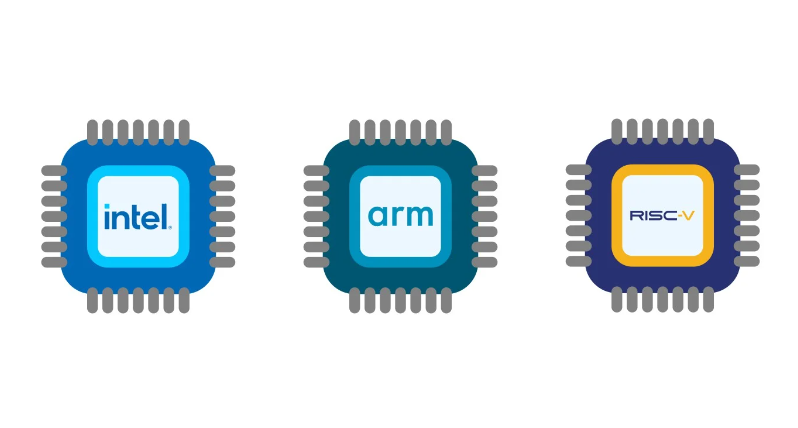
Today, the ISA landscape is dominated by three key architectures:
- x86 (CISC) — The backbone of desktop computing and servers, led by Intel, AMD, and a few others
- ARM (RISC) — Power-efficient and mobile-first, running nearly every smartphone on the planet and expanding into PCs and cloud computing
- RISC-V (RISC) — The open-source disruptor with rapid adoption in AI, IoT, and edge computing
Each has unique strengths, licensing models, and market positioning, shaping the semiconductor industry’s future.
What Is RISC-V?
RISC-V (pronounced “risk-five”) is an open-source ISA based on the principles of Reduced Instruction Set Computing (RISC).
Key characteristics of RISC-V:
- Open and free – no licensing fees
- Modular – you can include only the features you need
- Extensible – you can design your own custom instructions
Unlike traditional architectures, RISC-V is not owned by a single company. It is maintained by an open ecosystem of contributors and organizations.
Why RISC-V Matters
RISC-V is gaining attention across the tech industry for several important reasons:
1. No Licensing Costs
Traditional architectures like ARM require companies to pay licensing fees.
RISC-V removes this barrier, making it ideal for startups, research, and innovation.
2. Full Customization
Developers can design processors tailored to specific applications:
- AI acceleration
- Embedded systems
- High-performance computing
3. Growing Industry Support
Major technology companies are investing in RISC-V, making it a strong alternative to existing architectures.
4. Academic and Educational Value
Because it is open, RISC-V is perfect for learning how CPUs actually work.
RISC-V vs ARM vs x86
Here’s a simple comparison:
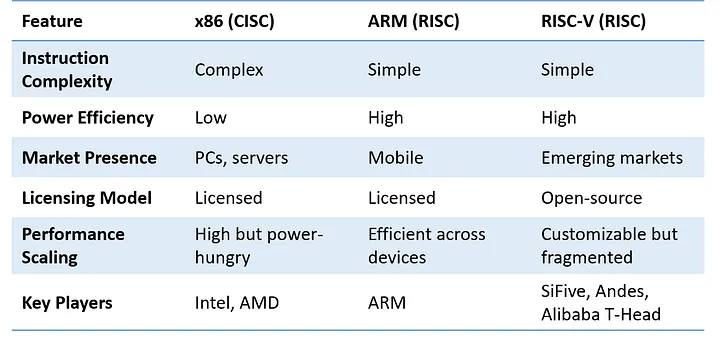
| Feature | RISC-V | ARM | x86 |
|---|---|---|---|
| License | Open (free) | Paid | Proprietary |
| Flexibility | High | Medium | Low |
| Customization | Full | Limited | Very limited |
| Ecosystem | Growing | Mature | Mature |
RISC-V stands out because of its openness and flexibility, while ARM and x86 dominate in established ecosystems.
How RISC-V Works (Basic Concept)
At a high level, a RISC-V processor works like any CPU:
- Fetch an instruction from memory
- Decode the instruction
- Execute the operation
- Write back the result
Core components include:
- Registers – small, fast storage inside the CPU
- ALU (Arithmetic Logic Unit) – performs calculations
- Control Unit – directs operations
RISC-V keeps instructions simple and efficient, which makes it easier to design and implement.
Where Is RISC-V Used?
RISC-V is already being used in a wide range of applications:
- Embedded systems and microcontrollers
- Internet of Things (IoT) devices
- AI and machine learning hardware
- Research and education
- Custom silicon development
As the ecosystem grows, RISC-V is expected to expand into even more areas.
What Can You Build with RISC-V?
One of the biggest advantages of RISC-V is that you can build your own processor.
With tools like FPGA, you can:
- Implement a RISC-V CPU
- Design your own instruction extensions
- Run programs on your custom hardware
This makes RISC-V not just a theory topic, but a hands-on engineering platform.
What to Learn Next
If you’re just getting started, here are the best next steps:
- Learn basic digital logic and Verilog
- Try running a simple RISC-V core on FPGA
- Build small components like an ALU
- Explore CPU design step by step
Conclusion
RISC-V represents a major shift in how processors are designed and used.
By being open, flexible, and accessible, it allows anyone — from students to engineers — to explore and build real computing systems.
If you want to truly understand how computers work at a deep level, RISC-V is one of the best places to start.